Enquire Now

Enquire Now

Underserved communities rely on Federally Qualified Health Centers (FQHCs) to access critical health care services. However, it can be challenging to administer Medicare cost reporting rules. Centers are required to keep accurate financial records, adhere to reporting requirements and provide full cost reports on time.
These reports are used for Medicare reimbursement, program cost evaluation, and to develop payment policies by the Centers for Medicare & Medicaid Services (CMS). Knowing the FQHC cost report deadlines, compliance requirements, and what CMS expects will help healthcare organizations to accurately report and minimize the risks that are avoidable.
FQHCs are required to submit financial and statistical data for administration of the Medicare programs. Form CMS-224-14 is typically the report form used by freestanding FQHCs for applicable reporting periods. Organizations are required to comply with the form instructions and Medicare cost reporting guidelines .
The CMS FQHC Information Center offers a variety of resources to support Medicare payment analysis, billing guidance and policy updates. It’s important for everyone to keep in mind that there needs to be some coordination between finance, billing, administrative, and clinical teams to get accurate reporting.
Compliance is a basic requirement, and a critical date for filing is the deadline. The federal regulations typically require cost reports to be submitted by the end of the fifth month after the end of the reporting period. Generally, the deadline for reporting is 150 days after the end of the reporting period when the reporting period does not end on a date that is divisible by 30. When the date of the reporting period is not the last day of the month, the deadline for the reporting is generally 150 days after the date of the reporting period.
For example, an FQHC with a December 31 fiscal year-end generally must submit its cost report by May 31 of the following year.
Providers should take these steps to manage deadlines effectively:
Extensions are not guaranteed. Federal regulations allow extensions for contractors if there are extraordinary circumstances that are out of the provider’s control.
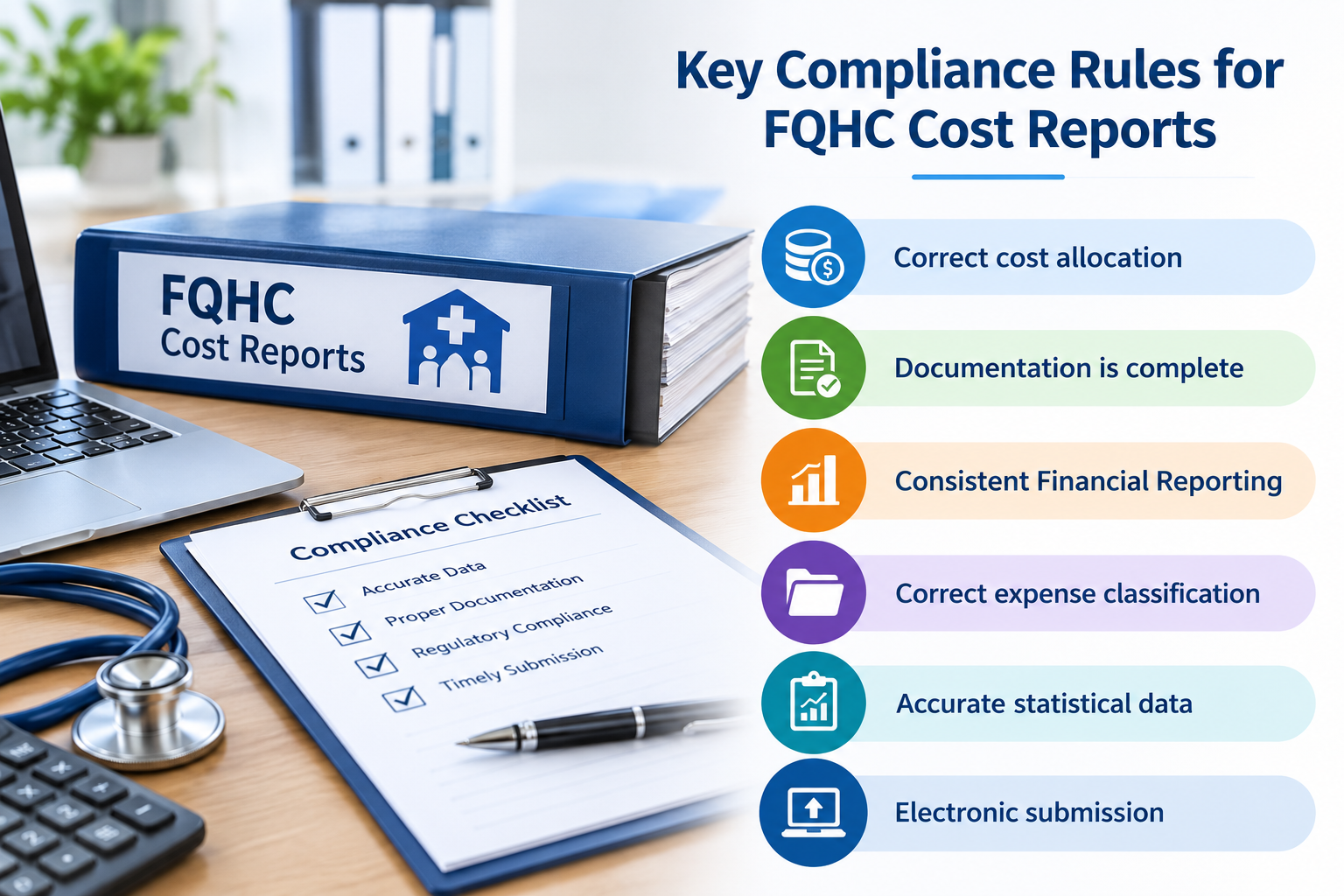
CMS anticipates providers will keep sufficient financial and statistical documentation that supports the reported cost. Organizations should have dependable systems in place to link accounting records and reported information.
Important compliance responsibilities include:
These practices help an organization show that its submissions are accurate and to answer any questions or reviews.
CMS expects FQHCs to report fully and accurately, and according to the instructions, to the form and Medicare’s reimbursement principles.
The following areas should be of special concern to providers:
Reported numbers should be consistent with accounting records and operations. If differences exist, they need to be investigated and documented.
Cost report forms, instructions, and electronic cost report specifications are regularly revised by CMS. It amended Chapter 44 of Form CMS-224-14 guidance on May 28, 2026. Providers must identify instructions for their reporting periods.
FQHCs need to report costs accurately, statistics relevant to the PPS, and information to include that may be related to the reimbursement of Medicare non-PPS items.
Organizations should keep supporting documentation and have clear procedures for providing answers to questions contractor(s) may ask. Good documentation provides supporting information to reported figures and assists with compliance checks.
Reporting problems can be created, even within established healthcare organizations, if there are internal control inconsistencies.
Common mistakes include:
FQHCs can minimize these risks by performing regular reconciliations, having specific reporting duties, and performing pre-submission reviews. Additional reporting accuracy can be provided by staff training and regular compliance testing.
FQHC cost reporting is complex, requires compliance with regulations and demands tight deadlines. Professional assistance can be used to define areas of reporting that may be missing and develop more consistent preparation procedures.
A formal review process can facilitate providers in:
In the end, a proactive strategy can benefit healthcare organizations in terms of better reporting reliability and enable employees to concentrate more on patient care.
The timeframes for FQHC cost report submission, the compliance regulations, and CMS expectations need to be paid attention to regularly. Good compliance practices include keeping accurate records, submitting electronically in time, up-to-date reporting instructions, and effective internal reviews.
Looking for assistance with FQHC cost reporting and compliance? If you need to discuss your reporting needs or would like to see professional assistance in preparing and reviewing your cost report, contact NMP Professional Services, Inc.
© 2026 NMP Professional Services, Inc. All Rights Reserved